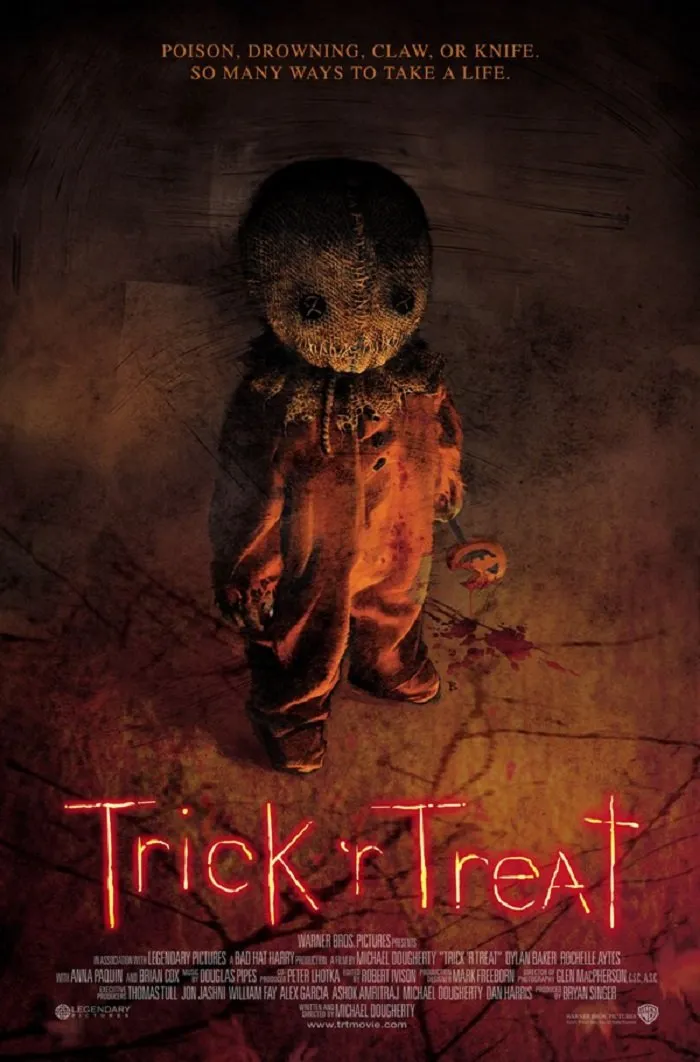
Trick ‘r Treat
- Year
- 2007
- Studio
- Warner Bros.
About this movie
Horror anthology of interwoven stories set on one Halloween night, watched over by the little guardian Sam.
Plot summary
The film takes place on Halloween night in the fictional town of Warren Valley, Ohio. The plot follows a nonlinear narrative, with characters crossing paths throughout the film. At the center of the story is Sam, a peculiar trick-or-treater in an orange footie pajama costume, who appears to enforce the "rules" of Halloween.
In the opening scene, Emma and her Halloween-loving husband Henry return home after a celebratory night. Emma, who secretly hates Halloween, blows out their jack-o'-lantern before midnight against Henry's advice. As Henry falls asleep in the house, Emma begins tearing down the decorations; but is then ambushed and murdered by an unseen assailant. Hours later, Henry discovers Emma's mutilated corpse on display with the decorations.
Overweight delinquent Charlie vandalizes jack-o'-lanterns and steals candy from unattended bowls. When school principal Steven Wilkins catches him red-handed, Steven offers Charlie a candy bar while lecturing him on the importance of respecting Halloween rules and traditions. Shortly after, Charlie begins vomiting violently. As Charlie dies, Steven, who is in fact a serial killer, reveals that he laced the candy with hydrofluoric acid.
From the Wikipedia article “Trick 'r Treat”, licensed CC BY-SA 4.0. Continue reading on Wikipedia
Details
- Holiday
- Halloween
- Archive type
- Movie
- Studio
- Warner Bros.
Credits
- Michael Dougherty Director
Where to watch
Find where to stream it Searches JustWatch
Memories
Personal recollections. They never change the facts above, but they’re why the archive exists.
Sign in to share what you remember
No memories yet. Be the first to share one.
Questions about this work
Was it sold at Kmart or Sears? Was there a green variation? Ask the collectors.
Sign in to ask the community.
More Halloween movies






Sources & verification
No sources cited yet. Catalog pages, ads, packaging, and UPC labels all count as evidence.